



PCI DSS
PCI DSS (Payment Card Industry Data Security Standard) is a globally recognized security standard for organizations that store, process, or transmit cardholder data. Established by the Payment Card Industry Security Standards Council, it ensures secure handling of credit and debit card information to prevent fraud and data breaches. Compliance with PCI DSS is mandatory for businesses that accept card payments, helping safeguard customer trust and protect sensitive financial data.
Why PCI DSS Compliance Matters
PCI DSS compliance is essential for protecting sensitive cardholder data from fraud, cyberattacks, and data breaches. It establishes strict security requirements for securely storing, processing, and transmitting payment information, helping businesses maintain a strong and reliable payment infrastructure.
By following PCI DSS standards set by the Payment Card Industry Security Standards Council, organizations reduce financial risks, avoid regulatory penalties, and strengthen customer confidence. Compliance not only safeguards financial data but also enhances overall cybersecurity practices across the business.

What PCI DSS Certification Means
PCI DSS certification is the process through which a business validates that it complies with the security standards defined by the Payment Card Industry Security Standards Council. It confirms that the organization has implemented the required controls to securely store, process, and transmit cardholder data.
The certification process typically involves security assessments, vulnerability scans, documentation reviews, and audits, depending on the transaction volume and compliance level of the business. Achieving PCI DSS certification demonstrates a strong commitment to data security, regulatory compliance, and customer trust.
Scoping & Readiness Assessment
Gap Assessment & Roadmap Development
Control Implementation Support
Documentation & Policy Development
Remediation Guidance & Advisory
Risk & Vulnerability Management Support
PCI DSS Audit Preparation
Certification Lifecycle Management
Continuous Monitoring & Managed Compliance
Essential For Businesses Handling Card Data
Install and Maintain Network Security
Implement firewalls and network protections to safeguard sensitive cardholder data.
Secure System Configurations
Standardize settings on all systems to reduce vulnerabilities.
Protect Stored Data
Encrypt or tokenize cardholder information to prevent unauthorized access.
Protect Data in Transit
Use robust encryption to secure cardholder data during transmission over public networks.
Protect Against Malware
Use antivirus tools and continuous monitoring to detect and prevent malicious software.
Keep Systems and Software Secure
Regularly update and patch all software and systems to maintain security.
Limit Access to Authorized Users
Ensure only personnel with a legitimate need can access cardholder data.
Verify User Access
Use strong identification and authentication methods for all users.
Restrict Physical Access
Protect locations where cardholder data is stored.
Monitor and Log Access
Keep records to track and detect any unauthorized access.
Perform Regular Testing
Carry out vulnerability scans and penetration tests to identify security gaps.
Implement Security Policies
Develop and enforce policies to maintain secure practices across the organization.
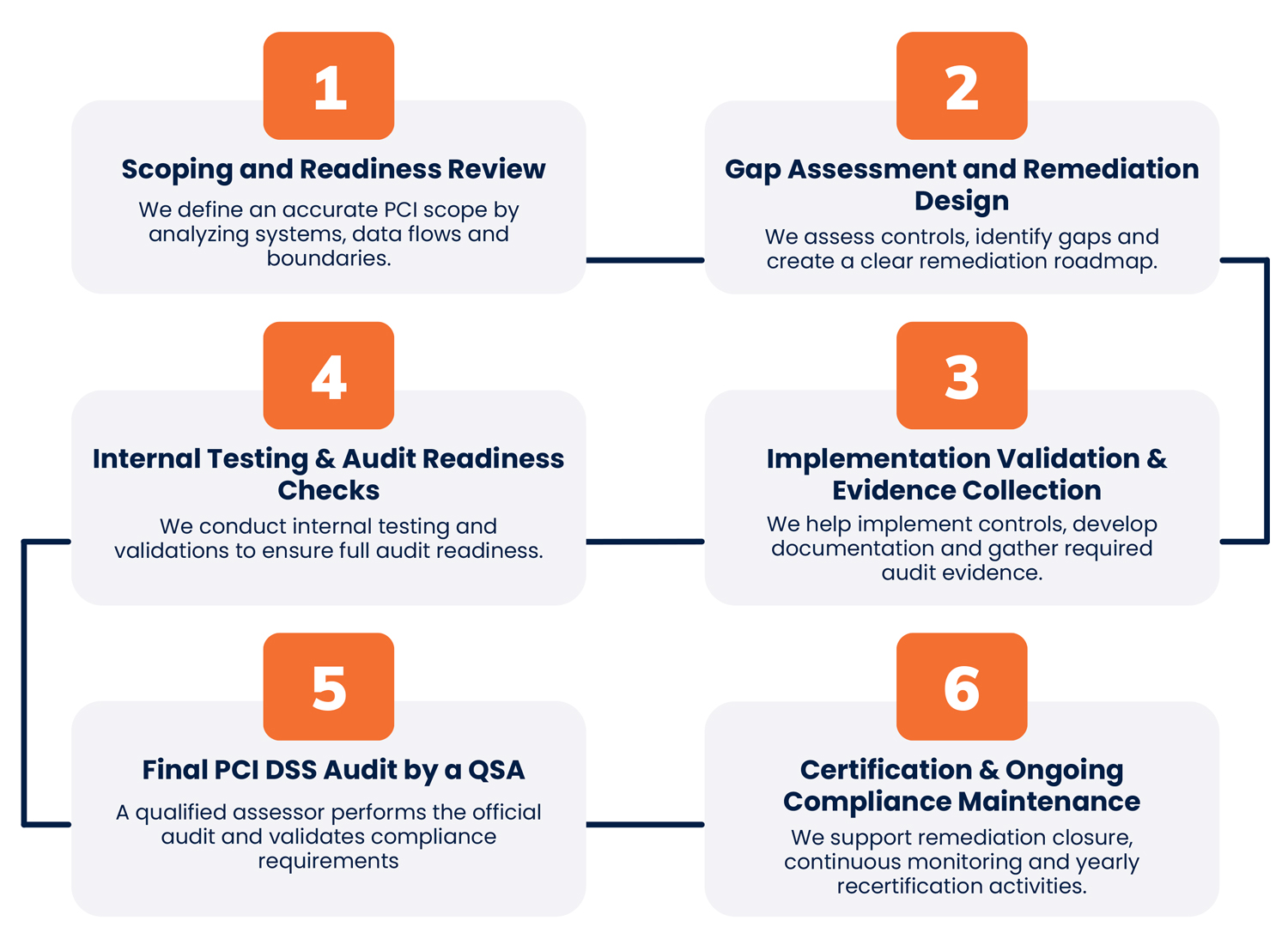
Our PCI DSS Certification Approach
A structured and efficient pathway to achieving secure, reliable, and fully compliant payment environments.
PCI DSS Compliance Levels
PCI DSS compliance is divided into four levels, determined by the number of credit or debit card transactions a business processes annually.
Security & Audit Standards
This level applies to merchants that process more than six million card transactions per year. Organizations at this level must undergo an annual assessment conducted by a Qualified Security Assessor (QSA) and complete a yearly internal audit. They are also required to perform quarterly network scans through an Approved Scanning Vendor (ASV) to maintain compliance.
Validation Process
Merchants processing between one and six million card transactions annually must complete a yearly Self-Assessment Questionnaire (SAQ). Depending on their business model and risk level, quarterly PCI scans may also be required to maintain PCI DSS compliance.
Merchant Requirements
This level applies to businesses processing 20,000 to one million e-commerce transactions per year. Merchants must complete the appropriate annual Self-Assessment Questionnaire (SAQ) and conduct quarterly PCI scans to confirm that required security controls are properly maintained.
Assessment Standards
Level 4 applies to merchants processing fewer than 20,000 e-commerce transactions per year or under one million total card transactions annually. These businesses must complete an annual Self-Assessment Questionnaire (SAQ) and may also need to perform quarterly PCI scans to maintain compliance.
Strengthen Your Security Today
Start your PCI DSS certification journey and reduce risk across your systems and payment environments.
PCI DSS v4.0
PCI DSS v4.0 modernizes global payment security by aligning compliance requirements with today’s complex digital and cloud-driven environments. It introduces risk-based validation, enhanced authentication measures, continuous monitoring, flexible control implementation, and stronger governance frameworks.
We support organizations in adopting PCI DSS v4.0 with confidence—establishing audit-ready processes, implementing robust security controls, and building long-term, sustainable compliance maturity.
Mandatory Controls in PCI DSS v4.0
Stronger security requirements for today’s evolving payment risk landscape.
PCI DSS v4.0 introduces enhanced controls focused on improved authentication, continuous monitoring, stronger governance, and secure development practices across payment environments.
01.
Enhanced Multi-Factor Authentication
Mandates MFA for administrative and remote access to minimize credential compromise and strengthen identity security controls.
02.
Continuous Monitoring Requirements
Requires continuous logging, alerting, analysis, and security monitoring to ensure ongoing compliance rather than one-time validation.
03.
Secure Coding Requirements
Mandates secure development practices, code reviews, testing, and SDLC controls to reduce the risk of application vulnerabilities and exploitation.
04.
Enhanced Password & Access Controls
Implements stricter password complexity standards, lifecycle management practices, and stronger access governance to minimize the risk of account compromise.
05.
Customizable Validation & Control Flexibility
Enables organizations to implement tailored security controls that provide equivalent protection, supported by proper justification and documented audit evidence.
01.
Expanded Security Testing Scope
Requires broader vulnerability assessments, enhanced penetration testing, and more frequent evaluations to proactively identify risks across evolving and hybrid infrastructures.
02.
Security Awareness & Training
Strengthens awareness programs to address phishing, emerging cyber threats, and human risk factors—building a more informed and vigilant workforce.
03.
Risk-Based Validation
Emphasizes prioritizing remediation based on risk severity and business impact, ensuring critical vulnerabilities are addressed promptly and effectively.
04.
Customized Compliance Approach
Allows organizations to implement alternative controls tailored to their architecture, achieving equivalent security outcomes without unnecessary disruption or operational complexity.
05.
Enhanced Authentication Standards
Expands multi-factor authentication requirements across all access accounts to strengthen identity verification and reduce the risk of credential compromise.
06.
Updated Encryption Standards
Mandates stronger cryptographic protocols for data storage and transmission, replacing outdated methods to safeguard sensitive information against advanced threats.
PCI SAQ – Self-Assessment Questionnaire
Compliance validation for lower-volume merchants The PCI SAQ enables eligible lower-volume businesses to validate PCI DSS compliance without a QSA-led audit. It requires accurate scoping of the cardholder data environment, correct SAQ selection, thorough self-assessment of applicable controls, documentation of compensating controls where needed, evidence validation, and submission of the Attestation of Compliance (AOC).
We support organizations with architectural scoping, SAQ type mapping, requirement interpretation, internal control validation, and response review—ensuring accurate submissions, reduced compliance risk, and alignment with assessor expectations.

SAQ A
SAQ A-EP
SAQ B
SAQ B-IP
SAQ C-VT
SAQ C
SAQ P2PE
SAQ D for Merchants
SAQ D for Service Providers

Why PCI DSS Compliance Is Essential
A critical standard for trust, market access, and long-term business resilience. PCI DSS compliance is vital for organizations that handle card payments. It safeguards customer data, reduces the risk of fraud and breaches, strengthens overall cybersecurity posture, and enhances credibility with customers, partners, and regulatory stakeholders. Beyond regulatory necessity, compliance promotes stronger operational controls and supports secure, sustainable business growth.
Without PCI DSS compliance, businesses may face:
- Suspension or loss of payment processing privileges
- Limited access to banking partnerships, enterprise contracts, and investor opportunities
- Greater exposure to data breaches and fraud incidents
- Reputational harm and erosion of customer trust
PCI DSS is more than a regulatory requirement—it forms the found
Choose the Right SAQ
We help determine the correct SAQ type to prevent inaccurate declarations, reduce compliance risk, and avoid submission rejections.
Why Choose Pentagon
Your Trusted Partner for PCI DSS Risk, Governance, and Certification
Pentagon is a PCI-focused and CERT-In empanelled organization delivering reliable PCI DSS certification and advisory services. With deep expertise in global compliance standards, we guide organizations through complex payment security requirements with clarity, confidence, and a structured approach to successful certification.
- PCI-focused and CERT-In empanelled organization
- Qualified Security Assessor (QSA)-certified consulting capability
- Experienced professionals with hands-on audit and compliance expertise
- Proven delivery across fintech, banking, payments, cloud, and enterprise environments
- Structured, governance-aligned methodologies designed to accelerate certification
- End-to-end PCI DSS support from initial readiness through continuous compliance
- Audit-ready documentation and evidence-driven validation processes
- Focus on sustainable compliance maturity and measurable risk reduction
Begin Your PCI Certification Today
Frequently Asked Questions
PCI DSS compliance refers to meeting the security requirements designed to protect cardholder data when storing, processing, or transmitting payment information.
Yes. Any business that accepts, processes, stores, or transmits credit or debit card data must comply with PCI DSS requirements as mandated by card networks.
The timeline depends on your organization’s size, infrastructure complexity, and current security maturity. It can range from a few weeks to several months.
Non-compliance can lead to financial penalties, increased risk of data breaches, reputational damage, and even suspension of payment processing privileges.
PCI DSS compliance must be validated annually, with additional requirements such as quarterly vulnerability scans and continuous monitoring depending on your compliance level.